
October 15, 2025
By Adeline Rowe
Students at Dallas Center-Grimes High School have always drank caffeinated drinks, but how much is too much?
According to the Journal of the Academy of Nutrition and Dietetics, adolescents should limit their caffeine intake to no more than 100 milligrams a day (Chapman). To put that into perspective, one 16 fl oz can of Monster Energy contains 160 milligrams of caffeine while a Starbucks coffee contains 330 milligrams of caffeine (Talpos). And according to a poll taken by 212 DCG students, 69% of those students drink anywhere from 1 to 10+ caffeinated beverages a week, which begs to ask, why are teenagers ingesting caffeine in the first place?
“I…it’s just like a pick-me-up,” says junior at DCG, Mady Brown. “…Iif I know I’m going to have a long day or if I just want something to treat myself.” A common reason for getting a “fun drink” such as a cup of coffee, a Bubblr, or an Alani seems to be the need for a pick-me-up. Why might teenagers need a pick-me-up?
“I work every single morning at 5 a.m. so that’s reason enough I suppose,” says junior Will Kestel, a junior at DCG, when asked for his main reason for getting a caffeinated drink. With students nearly living at schools nowadays because of the amount of activities and how much school asks of them, kids say they are tired and need that pick-me-up multiple times a week.it can be imagined why kids are feeling tired and needing that pick-me-up multiple times a week.
“I’m [also] a lot happier caffeinated,” saidsays Kestel., “I don’t have a headache when I have caffeine.”
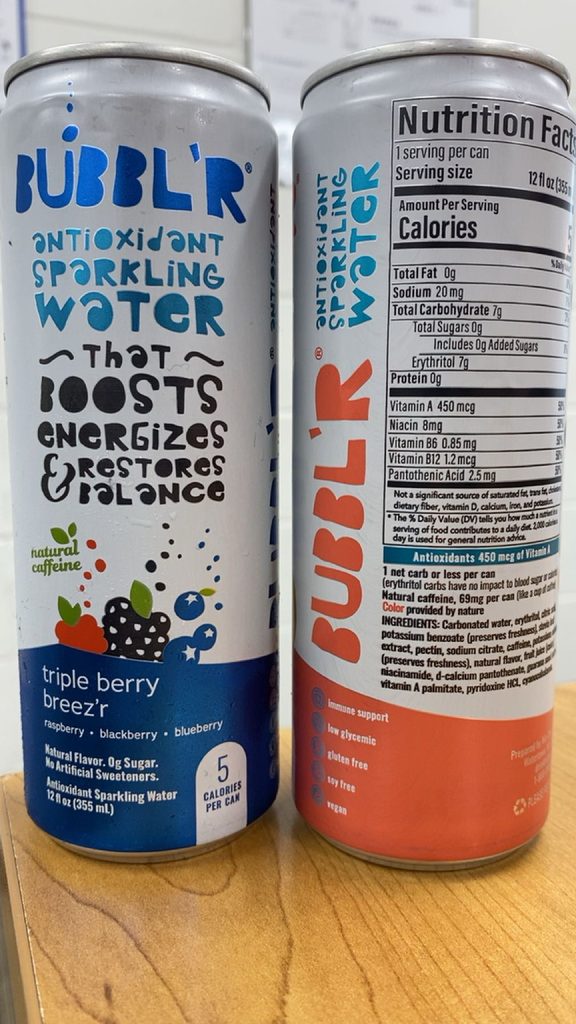
Caffeine can help increase alertness, attention, and energy but it can unfortunately also increase blood pressure, heart rate, and breathing. These can potentially lead to dehydration, heart complications, anxiety, and insomnia (CDC). With all of these negative consequences, teenagers must feel at least a little concerned with the possibility of a decline in their health.
“I feel like it’s just become so normalized that I don’t really think about [the bad effects] anymore,” says Brown.
In 2013, it was found that adolescents between the ages of 13 and 17 are frequent targets of energy drink marketing (Talpos). With the amount of normalcy around energy drinks today, it can only be imagined how often energy drink companies gear or center their entire product on appealing to adolescents.
With all this in mind, teenagers do not seem to be the only ones to blame. The intense expectations of involvement before, during, and after school with schoolwork, activities, and jobs as well as the marketing strategies of caffeinated beverage companies, should bear most of the weight of blame, not teenagers.
Works Cited
CDC. “The Buzz on Energy Drinks.” School Nutrition, 20 Sept. 2024, www.cdc.gov/school-nutrition/energy-drinks/index.html.
Chapman, Leah Elizabeth, et al. “Evaluation of Caffeinated Beverages Sold in a National Sample of U.S. Middle and High Schools.” Journal of the Academy of Nutrition and Dietetics, Mar. 2025, pp. S2212-2672(25)004988, pubmed.ncbi.nlm.nih.gov/40617463/, https://doi.org/10.1016/j.jand.2025.06.273.
Talpos, Sara. “In the Energy Drink Market, It’s Ads vs. Science.” Undark Magazine, 26 June 2019, undark.org/2019/06/26/kids-energy-drinks/.